

Ordinary citation
$337
70 penalty points
First write-up, corrected on the spot
Moderate negligence, a reasonably likely event, nobody hurt yet, a mid-size mine and a short violation history. This is close to the cheapest a real citation gets.
Mining economics
What a violation really costs once the assessment, the idle hours, the premium and the rework are added up — and what it takes away from a site over the years that come after. Priced from MSHA's own tables, not from opinion.
The bad day
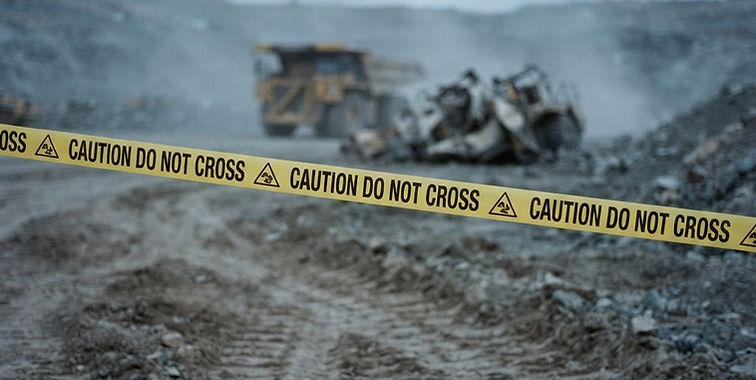
One damaged machine, one stopped crew, one tape line. Everything on this page is what that morning ends up costing.
One condition, three prices
These figures are not a survey and not an average. They are MSHA's own 30 CFR Part 100 scoring tables run on one guarding condition, changing only what an inspector finds around it: negligence, likelihood, severity, the miners exposed, the size of the mine, and its violation history.
Ordinary citation
$337
70 penalty points
Moderate negligence, a reasonably likely event, nobody hurt yet, a mid-size mine and a short violation history. This is close to the cheapest a real citation gets.
Unwarrantable failure
$27,603
125 penalty points
High negligence, a highly likely event, three miners exposed, and repeat violations of the same standard. Section 104(d)(1) puts a statutory floor under the score.
Order, event occurred
$81,584
192 penalty points · at the table ceiling
Reckless exposure, a fatality, ten or more miners affected, at a large operation with a long violation record. Scored at the ceiling of the 100.3 conversion table.
A violation that is not abated keeps costing $9,820 a day until it is. Ten days on a stalled order costs more than the assessment that started it.
Penalty table as adjusted for 2025 · MSHA re-indexes it annually
Where the money actually goes
Operators budget for the citation because it arrives as an invoice with a number on it. The other three layers arrive as payroll, premium and lost hours, which is why they are the ones that hurt and the ones nobody puts a line item against.
A civil penalty is the visible number and usually the smallest one. MSHA scores it from negligence, likelihood, severity, the miners exposed, the size of the mine and its controlling entity, and the violation history — which is why the same condition costs one operator hundreds and another operator tens of thousands.
A 104(b) withdrawal order, an equipment breakdown, an investigation, or a section held while an injury is sorted out all stop tons. Payroll, fuel, hauling contracts and customer commitments keep running whether or not the plant does. Run the arithmetic on your own tonnage per hour and the idle day is the expensive line, not the fine.
Workers’ compensation is experience-rated: your claim history is compared with what is expected for your payroll and classification, and that ratio multiplies your premium. A bad year does not just cost the claim, it raises the rate on the payroll you still have to run for the next several policy years.
Retraining, re-inspection, added guarding and engineering controls, corrective action plans, and the supervision hours spent on interviews and documentation. None of it produces a ton, and all of it lands on the same calendar as the work that does.
What the money buys
Every one of these is cheaper than the event it prevents, and most of them are also cheaper than the citation alone at the top of this page. The comparison is not safety against profit. It is predictable spend against unpredictable loss.
| The spend | Scale | What it prevents | What comes back |
|---|---|---|---|
| Part 46 / 48 refresher for every miner | $125 per miner online | The uncorrected hazard nobody recognized, and the 46.9 / 5000-23 documentation gap an inspector finds instead | The lowest cost per hour of risk reduction on the site, and the record that answers the first question after any incident |
| Guarding, berms and haul road controls | Capital, one time | Powered haulage and machinery incidents, the two categories that dominate fatalgrams year after year | Removes the citation, the withdrawal order and the claim before any of them exist |
| Dust, noise and exposure monitoring | Sampling and program cost, recurring | Chronic illness claims that arrive a decade later with the mine still named on them | Keeps the health record defensible, and keeps a future claim out of your experience rating |
| Pre-inspection walk-throughs and program audits | Days, not months | Repeat and significant-and-substantial findings that move a mine toward pattern-of-violations status | Findings get fixed while they are maintenance items instead of enforcement items |
| Written plans and current records | Administrative | The unprovable defense: no training record, no exam, no corrective action logged | Turns an argument with the inspector into a document hand-off |
Long-term viability
The quarterly cost is the easy part to see. The harder question is whether the site can still be insured, bonded, permitted, staffed and sold five years from now. Each of these is decided by the same record.
Premiums, deductibles and the willingness of a carrier to write the account all move with claim history. For a small operator, a single bad year can change whether coverage is available at all, and no coverage means no work.
Bond is held against the reclamation obligation, and release comes in stages tied to completed work and compliance history. A contested release ties up capital that was supposed to come back to the business.
Renewals, modifications and expansions draw comment. A violation record and a fatality history are the exhibits opponents bring, and they turn a routine approval into a hearing.
Owners, general contractors and industrial buyers screen subcontractors on injury rates, experience modification and MSHA documentation before a purchase order is issued. A poor record quietly loses bids you never hear about.
Experienced operators are the scarcest input in mining. Crews stay where the work is done safely and leave where it is not, and the cost of replacing an experienced operator is measured in months of reduced production.
A reserve is a schedule, not a promise. Every unplanned outage pushes the remaining tons further out, and a mine that cannot run predictably cannot be financed, expanded or sold on its reserve.
Run your own numbers
Put your own payroll hours and your own tonnage per hour against those two columns. The training line does not move. The incident line does.
100 miners working a full year is roughly 200,000 hours. That figure is the denominator in every injury rate your customers and insurers use, which means one lost-time injury moves your rate by about 1.0 — visible on the next prequalification form.
An annual refresher for all 100 miners at $125 runs $12,500. That is the entire training line for the year, and it is a fixed, predictable number you can put in a budget.
A single lost-time claim is priced in the opposite way: the medical and indemnity cost, the overtime for the rest of the crew, the retraining, the investigation, the idle equipment, the premium adjustment on next year’s policy, and the supervision hours. Almost none of it is knowable in advance, and all of it is avoidable in most cases.
Next step